Why Another Checklist?
You can navigate the checklist using the menu on the right.
This project started in 2006 as a way to try to explain to some friends some of the new ideas that might lead to rather drastic changes in bird checklists. Well, they have. The initial intent was to focus on the Metaves hypothesis and potential changes in a broadly defined “Emberizidae”, meaning everything after the Fringillidae. The treatment of both has changed substantially since then, as have many other groups. The postulated Metaves has been broken up into several supraordinal fragments. Its remnants include, Mirandornithes, Opisthocomimorphae, Columbimorphae, Eurypygimorphae, and Strisores. The Passeriformes have also undergone drastic changes.
As I started to write it up, I noticed more and more changes both being made to bird checklists and in the literature. The project grew into a longish essay I put on the web in 2007. However, the more I worked on it, the more there was to do! I found that a family-level listing wasn't enough. The composition of the families was changing too. I needed to go down to the generic or even species level. To properly track the changes, I needed my own world checklist.
Unlike other checklists, this one is based on genetic studies to the highest degree possible. With one or two exceptions, it relies on published studies (including those available “ahead of print”). The strong focus on genetics means that previous morphological studies are often treated as second-class citizens. This is especially true when they aren't consistent with the genetic data, even if the genetic data is somewhat soft. Nonetheless, I rely on such analyses to fill in the gaps left by the genetic data.
My approach contrasts with most checklist committees. They usually put substantial weight on traditional classifications, and try to avoid speculation, even when its clear that the traditional classification is wrong. In particular, they try to avoid making erroneous changes, and put a premium on stability.
This checklist has a different purpose. It exists to speculate, to map out potential changes in the taxonomy. The price of focusing on speculation is to give up stability. I try to avoid erroneously maintaining the status quo, and try to keep abreast of the latest findings, even if incomplete.
The truth is that much of the genetic analysis is incomplete. It is still the case that only part of the avian tree has reliable results. For the rest, some is still relatively uninvestigated, some has results that are not clear cut or even contradictory, and some studies are not well executed. In some cases I've taken my best guess based on available data, sometimes speculating well beyond the genetic data.
The instability of the TiF worldlist may make it unsuitable for everyday use, although it should serve the useful function of highlighting potential changes regardless of your preferred checklist. Unlike a printed checklist, the TiF web list can be easily updated as new information, corrections, and better interpretations come to my attention. The “What's New” button at the top will show you the latest changes.
Previously, only the combination of Sibley and Monroe (1990) and Sibley and Ahlquist (1990) or its precursor in the Auk (Sibley, Ahlquist, and Monroe, 1988) had attempted anything of this sort (their famous “tapestry”). From the beginning, the TiF list has used an explicit family-level tree. That has now been extended to a genus-level tree for most families. In some cases it has been pushed to the species level, and in a very few cases, to subspecies.
The Checklist
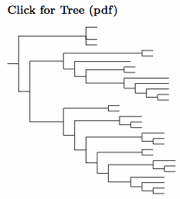
The TiF checklist currently (mid-2024) groups the extant bird species into 47 Orders and 259 families. The pdf of the ordinal-level tree has been updated based on Stiller et al. (2024). An older family-level tree is also available in pdf format. Due to its length, the family tree is spread accross 5 pages. Subsequent family changes have increased their number to 259.
 |
|
| 47 Orders | 252 Families |
|---|
Currently, only the annotated checklist is available. It starts with a discussion of the Palaeognaths (ostriches and related species).
Viewing the Checklist
You can view an annotated version by clicking on the menu on the right, or by using the family index or genus index. In the annotated list, recently extinct species and species whose taxonomic placement is particularly uncertain are color-coded. In some cases, superfamilies, subfamilies, tribes, and other groups have been added to help show how the birds are related.
Influences and Resources
The ultimate influences on the TiF list are Charles Sibley, Jon Ahlquist, and Burt Monroe. The Sibley-Monore (1993) checklist and the two earlier volumes by Sibley and Monroe (1990) and Sibley and Ahlquist (1990) sparked my interest in avian taxonomy. In some sense, the TiF list is an attempt to redo their tapestry based on modern genetic studies.
The TiF list was originally based on the 3rd edition Howard and Moore checklist, but the species list has been modified based on decisions by recognized authorities and publications in ornithological journals. The overall species list is now most similar to the IOC list. The IOC list has the advantage of quickly adopting recent changes in taxonomy. Now that they have expanded it to include subspecies and the other amenities of the Howard and Moore list, it has become my base reference. I have also made heavy use of the SACC (South American Classification Committee) and HBW / Birds of the World projects. The SACC is to be particularly commended for their pioneering open revision process. It provides unparalleled information about why particular taxonomic changes were made. The NACC (North American Classification Committee) has since stepped up its game. Recent NACC proposals and comments are also available.
There are numerous other checklists available on the web. For ABA listers, the venerable Clements checklist is now updated by Cornell, approximately annually. It is the basis for eBird. Those focusing on conservation issues may prefer the HBW / Bird Life International Checklist, which is also updated annually.
Besides the world checklists, there are various other taxonomic resources available on the web. BirdForum's Bird Taxonomy and Nomenclature Forum discusses the latest taxonomic issues. Don Roberson's Bird Families of the World has long followed the ongoing shake-up in bird families.
I've found Alan Peterson's Zoonomen particularly helpful for sorting out the complexities of scientific names. Finally, Birds of the World includes some of the text from HBW together with a wealth of photos and videos.
Acknowledgements
I thank Geir Sverre Andersen, Manual Andrés-Moreno, Gustav Asplund, Norbert Bahr, Keith Bennett, David Cole, John Croxall, Thomas Donegan, Stefan Ericsson, Dale Herter, Liam Hughes, Richard Jackson, James A. Jobling, Colin Jones, Leo Joseph, Max Kirsch, Peter Kovalik, Thomas Kuenzel, Marek Kuziemko, Wich'yanan Limparungpatthanakij, Lothar Lorenz, Pietro Martini, Heidi Michelle, Dale Mitchell, D. James Mountjoy, Stephen P. Nawrocki, Jack Neubart, Jonas Nordin, †John Penhallurick, Daniel Philippe, Stephan Pickering, Steve Preddy, Sandy Rae, Michael Ramsey, Laurent Raty, Thomas S. Schulenberg, Nathan Terzaghi, Ben Wielstra, Victor S. Zhukov, Kristof Zyskowski, and others for their helpful comments and suggestions.